ALREADY IN USE.
In the 2026 Legal Industry Report, 69 percent of legal professionals personally used generative AI, while 54 percent said their firm provided no training and had no plans to. Usage is moving faster than firm policy.
FOR LAW FIRMS
The question is whether the firm controls where client files go and how the work gets checked. Put an approved tool on the firm’s own network.
01 / WHY LOCAL
PUBLIC CLOUD / EXTERNAL
In the 2026 Legal Industry Report, 69 percent of legal professionals personally used generative AI, while 54 percent said their firm provided no training and had no plans to. Usage is moving faster than firm policy.
ABA Opinion 512 requires a fact-specific evaluation of the client, matter, task, and tool. A local machine does not erase that duty. It gives the firm a controlled place to work and a system its lawyers can actually supervise.
Leading legal research products still hallucinated in Stanford’s benchmark. The duty to verify every authority remains with the lawyer. The Node is for controlled drafting and file analysis, not unquestioned legal research.
PRIMARY SOURCESABA / 2026 INDUSTRY REPORT ABA / FORMAL OPINION 512 STANFORD / LEGAL RAG STUDY
02 / EXAMPLES
The deposition ran long and the summary is due tomorrow. An associate has four hundred pages of transcript and a folder of exhibits. A public chatbot could make the first pass, but the firm has not approved that account for client files.
With a Node in the server closet, the associate loads the transcript into a machine on the firm’s network. The summary and exhibit index come back, and the associate leaves before nine. The files stay inside the firm.
Six leases contain different versions of the same escalation clause. A staff member asks the Node to build a tool that reads all six and prints a comparison table. Twenty minutes later, the tool is working on the shared drive.
The staff member who requested it is not a programmer.
Both jobs stay on the firm’s network.
THE CARRIER
Legal malpractice applications now ask whether the firm permits AI to draft documents and request an explanation when the answer is yes.
A firm with a Node can answer plainly: drafting happens on a sealed machine inside the firm, client files do not go to an AI vendor, and lawyers remain responsible for review.
“Allow the use of Artificial Intelligence software to draft documents. If checked, please attach description.”
AMTRUST LPL APPLICATION, FORM LPLPRO-APP-01
03 / WHAT YOU GET
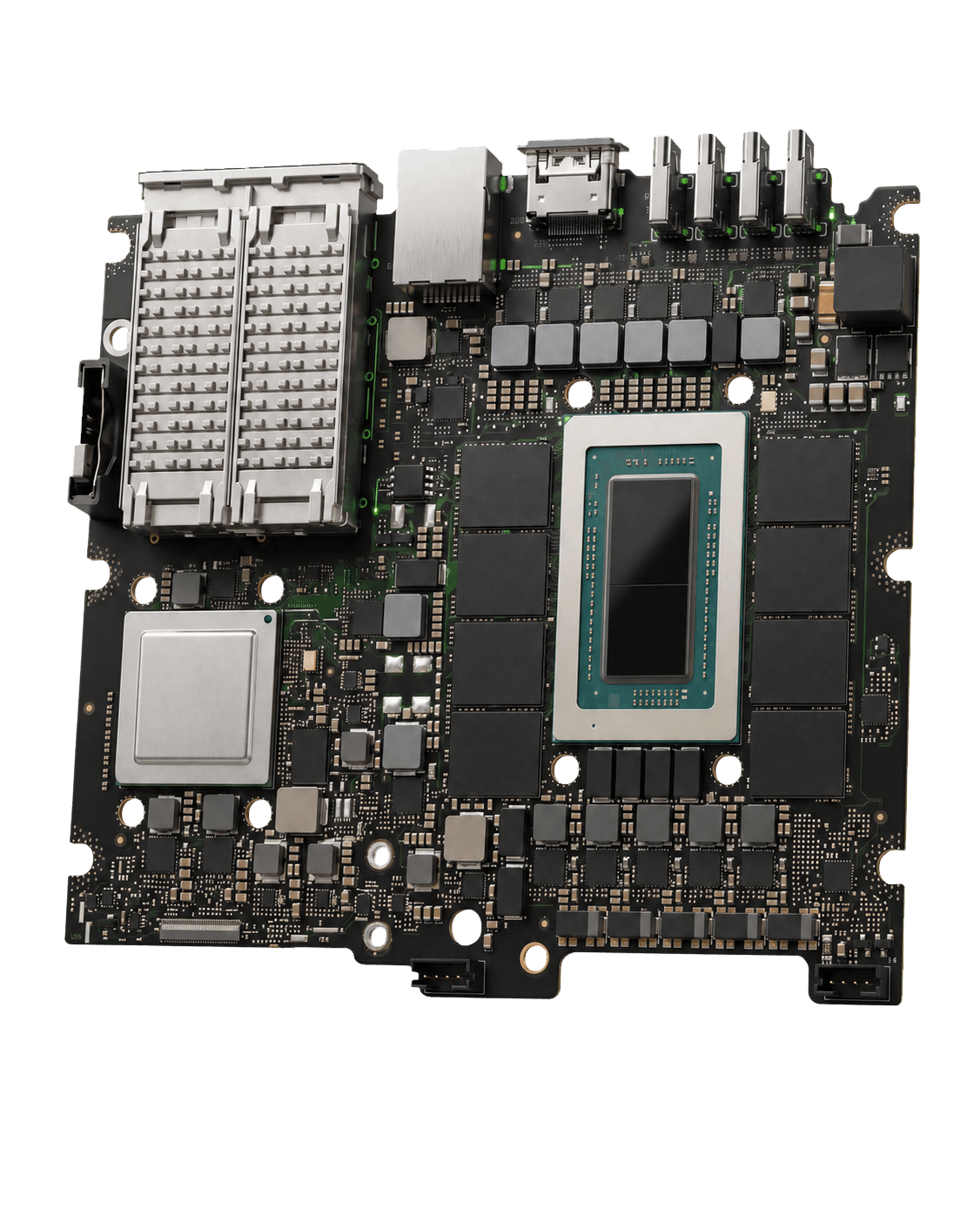
A sealed machine on your own network, configured and maintained by Splay inside your firm. Staff use it to draft and compare agreements, summarize depositions and discovery, write the small tools nobody budgets for, and search every matter file you could never upload.
It needs no cloud account and no internet connection, and nobody pays per seat. We maintain the machine without ever holding your files. The whole setup is written down, step by step; any competent IT shop could run it without us.
04 / WHAT IT DOES
A Node runs an AI model inside your building. Staff use it to draft documents, build small tools, and search files that cannot go to a public service.
Staff describe a small tool in plain English. The Node writes the code, and the tool runs on your network.
Intranet pages, forms, and working dashboards built from a plain description.
Proposals, compliance matrices, SOPs, contract reviews, letters, and summaries in your templates.
A vision model can read scanned drawings and photos of parts.
Every Node supports the same types of work. Larger machines handle more users, larger models, or faster answers. The pilot lets you test one with your own work.
05 / THE MACHINES
Five standard machines and one custom build. Each runs on your network with no path to the internet. Hardware, capacity, and prices are listed on every card.
If the listed machines do not fit your workload, Splay can build one to order. Memory, speed, and models are set after a call and quoted in writing.
NODE 01 serves 1-15 staff.
A second Spark and one cable turn NODE 01 into NODE 02.
Two more make NODE 03. Nothing is replaced or migrated.
What you paid counts in full from NODE 01 through NODE 03.
NODE 03 is built for more users. NODE 04 is built for faster answers. NODE 04 uses four RTX PRO 6000 cards, each with 1,792 GB/s of memory bandwidth. One Spark has 273 GB/s. Both can run GLM-5.2.
The firm places one order. There are no usage charges or per-seat fees. Spark machines upgrade by joining, and what you paid credits in full from NODE 01 through 03. Credits toward NODE 04 and 09 are set by quote.
MODEL LEDGER / JULY 2026
Published open models against the machines. The verdict is arithmetic over each model's published size and each machine's installed memory, nothing else. The flag is the developer's home country.
The estimate covers the model itself plus 5% overhead; working memory is extra. Sizes are the published figures.
Model score: best closed model = 100 on the Artificial Analysis index, July 2026. Raw scores 38, 40, 51, 44, 51 against the best closed model's 60. Model fit includes 5% overhead; working memory is extra. NODE 04 and 09 are built to order: 50% deposit, quotes hold 30 days. Prices subject to change.
06 / COST
Public tools remain fine for public work. Paxton publishes $2,999 a lawyer a year; Harvey routes to a demo request and CoCounsel routes to a quote. A machine alone does not discharge your ethical duties.
07 / PRICING
These are Splay's current published prices.
A sealed enclave built inside your firm: its own walled-off network, a bay for your Node, screens that can view but never copy, and a documentation pack for client security questionnaires.
$25,000 TO 10 SEATS$45,000 TO 25 SEATSFixed price; the machine is priced separately. You own it, and your IT runs it with our manual.
* Credited in full against any machine. Courses use your own examples. Custom models are tuned on your hardware. Extra on-site work is $2,400 a day.
Model drop: each quarter's best open model, installed and briefed on-site. Included with NODE 04/09 care. AI officer: a standing operator for prompts, workflows, and small tools.
08 / FROM CALL TO INSTALL
A 20-minute call about your network, staff, and work.
A readiness survey at your facility. $2,400, credited in full against any machine.
A pilot machine on your bench for 30 days. $2,000, credited in full. Then you decide.
A fleet of four pilot machines exists. Every machine is a copy of one documented setup, with a step-by-step manual; any competent IT shop could run it without us.
09 / FAQ
Any model can, and the dedicated legal tools are not immune: Stanford's 2024 benchmark measured hallucination rates of 17 to 34 percent in the leading AI research products. The duty to check authority stays with the lawyer, on every tool. What a Node changes is where the work happens: drafts and client files stay inside the firm.
Not automatically. ABA Opinion 512 says the analysis depends on the client, matter, task, and tool. It requires informed consent before representation information enters a self-learning tool that may expose it to others. A Node is not self-learning and sends nothing to a third party. Your ethics counsel still decides what belongs in the engagement letter; we put the machine's architecture in writing for that conversation.
Yes. Staff describe a tool in plain English and the machine writes the code. It works best for small internal tools and scripts. Large production systems still need a software team. The pilot lets you test it with your own work.
Your IT does, with our manual. Every machine is a copy of one documented setup. If you would rather we watch it, managed care starts at $600 a month and year one is included with every machine.
You own the machine outright, and the whole setup is written down, step by step. Any competent IT shop could run it without us.
A pilot machine sits on your bench for 30 days for $2,000, credited in full against any machine. So is the $2,400 readiness survey.
$0. The machine is the cost. NODE 01 serves 1 to 15 staff; when you outgrow a machine you buy the next machine, not the next license.
Each person uses the Node over your network. What limits a machine is how many answers it writes at the same time. NODE 01 is bench-measured at ten simultaneous conversations. Larger machines serve more people, and Splay sets the working memory during installation so the machine stays responsive.
You add machines. A second Spark turns NODE 01 into NODE 02; four Sparks make NODE 03. What you paid is credited in full from NODE 01 through NODE 03. Credits toward NODE 04 and NODE 09 are set by quote.
No. The machine has no path out to the internet, and your files stay in your building. Custom models are tuned and tested on your hardware, and support visits happen on-site, at the rate on the card.
So buyers can compare the machines before a call. Model scores come from a public index, and the raw scores are printed on the page. Every price carries its edition date: July 22, 2026.
10 / CONTACT
Splay is based in Stafford, Virginia, and installs on site across Northern Virginia—including Arlington, Alexandria, Fairfax, Loudoun, and Prince William—and Washington, DC. Start with a 20-minute call.